
Research / Papers / Methods Paper No. 1
Deterministic Classification of Goods against Export Control Lists: Method and Guarantees
- No statistical model decides. The same list edition and the same facts give the same result on every run.
- Each list ends in one of three results: candidate, not listed or open. Only a stated value can refute a position.
- A confirmed result is stored with the list edition, the facts, their sources and a hash over them.
Abstract
We describe the method by which Caelex classifies a good against an export control list. The official wording of a list edition is compiled once into machine-readable conditions. Facts about the good are recorded with their source. A fixed rule evaluation, without a statistical model, reads each list position as met, refuted or open. A position is reported as a candidate only when every one of its conditions is met by a stated fact, and a list is reported as “not listed” only when every position reached is refuted by one. Everything else stays open and is put to a person as a question. Results are confirmed by a person, and the confirmed result is stored with the list edition, the facts and a hash over them. The method is built so that a missing fact can never produce a release. This paper states the method and its limits. It does not publish the compiled lists, the compiler or the test sets.
Keywords: export control, dual-use, classification, three-valued logic, provenance, auditability
1 Introduction
Export control lists describe controlled goods by technical conditions, not by product names. A position of Annex I to Regulation (EU) 2021/821 [1] or of the Commerce Control List [2] typically names a kind of item and then one or more thresholds, joined by “and”, “or”, “all of the following” and “any of the following”, and qualified by Notes that include or exclude cases. Classifying a good means deciding, for each position that could apply, whether the good meets that wording.
In practice this is done by hand. An export control officer reads the datasheet, finds the positions that might apply, and compares values against thresholds. The work is slow, and its two possible errors are not symmetric:
A false hit costs time: an item is treated as controlled and a licence is sought that was not needed.
A false “not listed” is the costly error: a controlled item is shipped without a licence.
A method for this task therefore has to be judged first by how it avoids the second error, and only then by how often it reaches a decision. Systems that return the most probable answer are a poor fit, because “probably not listed” is not a statement an exporter can act on or defend in an audit.
The method described here takes a different route. It does not estimate. It evaluates the wording of the list against stated facts and separates three cases: the wording is met, the wording is refuted, or the facts do not suffice. The third case is treated as a first-class result.
The paper is organised as follows. Section 2 states the design goals. Section 3 gives an overview. Sections 4 to 7 describe inputs, evaluation, the dialogue with the user and the stored record. Section 8 covers the role of language models and validation. Section 9 states the limitations.
2 Design goals
The method is built to hold five properties. Each is stated so that a third party can check it.
| # | Property | Statement |
|---|---|---|
| G1 | Determinism | The same list edition and the same facts give the same result, on every run. No step that decides uses a statistical model. |
| G2 | Fidelity to the wording | Every condition evaluated is derived from the official text of the list edition, and each result names the position and the wording it rests on. |
| G3 | Fail-safe under missing facts | A fact that is missing or marked unknown can keep a position open. It can never refute a position and never contributes to “not listed”. |
| G4 | Human decision | The software proposes; a person confirms. No result takes effect without a confirmation by a named user. |
| G5 | Auditability | A confirmed result is stored with the list edition, the facts and their sources, so that it can be re-read and re-checked later against the edition it was confirmed on. |
G3 is the property that separates this method from ranking approaches. It makes the open state the default: a decision has to be earned by facts, in either direction.
3 Overview
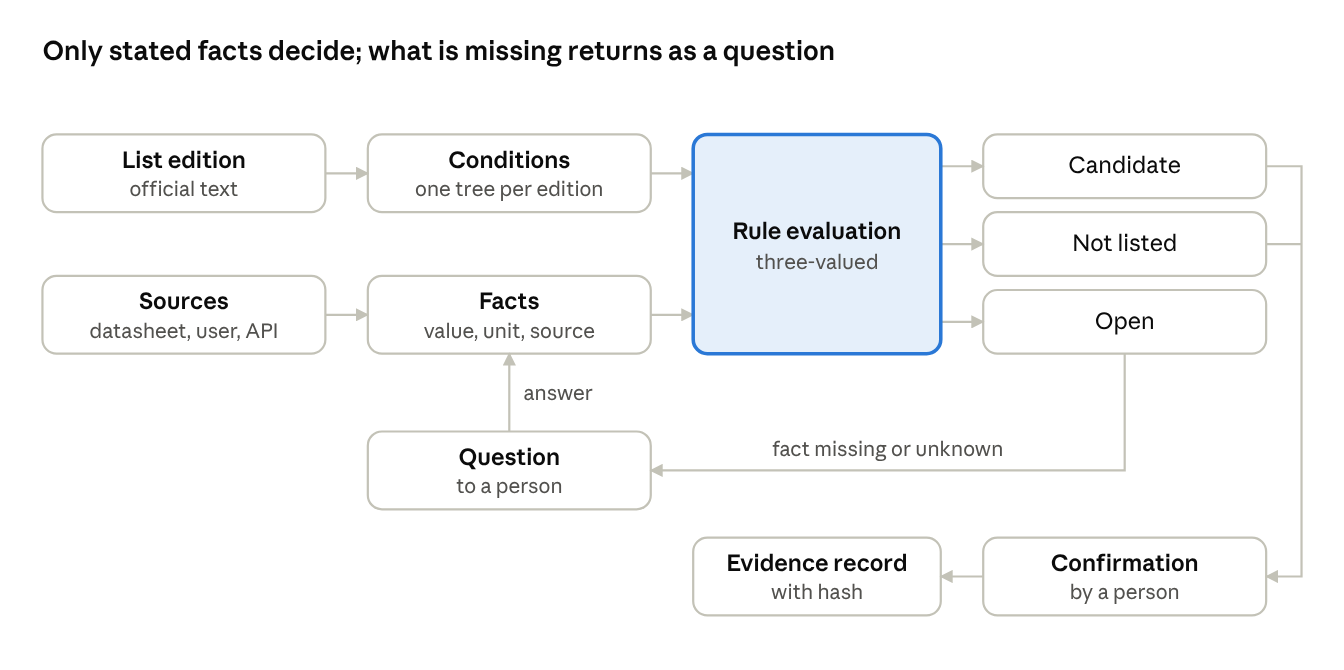
The list edition and the facts meet in one rule evaluation. A candidate or a “not listed” result goes to a person for confirmation and becomes a record. An open result returns as a question, and the answer becomes a new fact.
4 Inputs
The evaluation has two inputs: a list edition and a set of facts. Both are fixed before anything is evaluated.
4.1 List editions
A list is read in a named edition, for example one publication of Annex I in the Official Journal. The official text of the edition is ingested once and compiled into a tree of positions. The compilation follows the structure the legal text itself has:
A position inherits the conditions of every heading above it. A sub-item applies only inside its headings.
“All of the following” becomes a conjunction, “any of the following” a disjunction.
A threshold in the wording becomes a comparison on a named quantity with its unit.
A Note that takes cases out of control becomes an exclusion on the positions it belongs to.
Wording that cannot be reduced to a comparison, such as “specially designed for”, stays a clause that a person answers with yes, no or unknown.
Each compiled condition keeps the wording it was derived from. The edition is identified by a hash over its position tree, and every result names the editions it read. A check “as of” a date reads each list in the edition in force on that day.
4.2 Facts
A fact is a value for one attribute of the good: a number with a unit, a yes or no, or one option from a fixed set. Each fact carries its source: a place in a datasheet (page and position), an entry by the user, an answer from a supplier or engineer, or a value sent through the interface. Units are converted within one quantity (µm to nm, kW to W); a unit of a different quantity is refused, not reinterpreted.
A fact can also be recorded as unknown. This is different from absent: it says a person was asked and could not answer. Section 5 shows why the distinction matters.
5 Evaluation
The evaluation is a fixed rule computation. It can be stated compactly in three-valued logic in the sense of Kleene [3].
5.1 Conditions
Let F be the set of facts and c a condition on an attribute a. The value of c under F is 1 (met), 0 (refuted) or ⊥ (open):
Only a stated value can produce 0. This is design goal G3 in formal terms.
5.2 Positions
A position p is a formula over its conditions, built from the conjunctions and disjunctions of the wording, and reduced by its exclusions E(p). With the order 0 < ⊥ < 1:
A conjunction is refuted as soon as one of its conditions is refuted, whatever the others are. It is met only when all are met. A single open condition keeps it open.
5.3 Result per list
Let R be the positions of a list that the kind of good can reach. The result for that list is one of three:
| Result | Condition | Meaning for the user |
|---|---|---|
| Candidate | at least one p in R with v(p, F) = 1 | The wording of p is met by the stated facts. The user confirms or rejects it. |
| Not listed | every p in R has v(p, F) = 0, and R is complete for this kind of good | Each position reached is refuted by a stated value. |
| Open | otherwise | At least one position can still apply. The missing facts are named. |
Two consequences follow directly. First, adding a fact can move a position from open to met or to refuted, but an unknown never moves anything towards “not listed”. Second, “not listed” is a statement about the positions checked, on the edition named. It is not a statement that an item is free of control: other lists, end-use controls and sanctions are separate questions.
5.4 Confidence
A candidate carries one of three levels: high, medium or low. The level is not a probability. It follows from which conditions were met by measured values and how close a met value lies to its threshold. The method does not output percentages.
6 Questions and confirmation
6.1 The next question
When a list is open, the open conditions of Section 5 are exactly the facts that are missing. The next question is taken from them by a fixed rule, not generated: it follows a fixed order over the open conditions, and it asks a question about a heading before the measurements below that heading. Each question names the attribute, its unit and, where the wording is a clause, the official text of that clause.
The user may answer “I do not know”. The answer is recorded as unknown, the question is not asked again, and the positions that depend on it stay open. The dialogue ends when every list is decided or when nothing answerable is left.
6.2 Confirmation
A candidate is a proposal. The user selects it, or declares a different position with a reason, or leaves the item open. The software never stores its first proposal as a decision on its own. Where an organisation requires it, a second person confirms before the result counts as released (four-eyes).
For large article masters, rows that are identical in everything the evaluation reads can be decided together. Such a group decision requires that a person judged a sample of its rows, and a row that carries facts of its own is kept out of the group.
7 Evidence record
A confirmed result is stored as a record. The record is the unit an auditor reads. It holds:
| Part | Content |
|---|---|
| Item | Article number, manufacturer, country of origin, kind of good |
| Editions | Each list read, with its edition |
| Facts | Every fact used, with value, unit, source and whether a person confirmed it |
| Result | Per list: the confirmed position, “not listed” or open, with the conditions met |
| Refuted neighbours | Positions that were reached and refuted, each with the value that refuted it |
| Decision | Who confirmed, when, and under which release rule |
| Hash | A hash over the position, the list edition and the values the result rests on |
The refuted neighbours matter as much as the hit. They show that nearby positions were looked at and why they do not apply, which is the part of a manual classification that is rarely written down.
A record is read against the edition it was confirmed on. When a new edition of a list comes into force, stored records are evaluated again against it, and a record whose result would differ is put back in front of a person. It is not changed silently. Records can be exported as text, CSV and PDF.
8 Language models and validation
8.1 Where a language model may take part
No language model decides a classification, proposes a list position or sets a confidence level. The evaluation of Section 5 runs without one.
Reading a datasheet is a different step. By default it is done by fixed text rules. An organisation can switch on a language model for this step only. The model then points to a place in the datasheet where a value stands; the number at that place is read by the same fixed rules, and the value is marked with its source as read with a model. Wording of list positions that our safety rules set apart is never handed to a model.
8.2 Validation
The method is tested at three levels:
Against the official text. Compiled conditions are compared with the wording of the edition, by automated checks and by sampling: conjunctions and disjunctions, thresholds, exclusions and references.
Against fixed cases. A regression set of cases with an expected result per list runs before every release. A release that changes any expected result is stopped until the change is explained.
Against independent judgement. The benchmark programme adds a held-out test set, judged independently by two domain experts. Its leading measure is the rate of false “not listed” results, reported together with the share of cases decided, because a method that always answers “open” would score perfectly on the first and be useless.
This paper states the method. Benchmark figures will be published separately, each with its test set hash, list editions and confidence intervals.
9 Limitations
Not legal advice. The software shows sources and evaluates stated facts against the wording of a list. It does not grant a licence and does not replace the judgement of the person responsible for export control.
Compilation is checked, not assumed. A condition is only as good as its derivation from the text. Sampling against the official text is how deviations are found, such as a threshold read as an equality or a frequency band read too narrowly. Each finding is corrected in the compiled edition and recorded, and acceptance by domain experts proceeds position by position.
Facts can be wrong. The evaluation is correct relative to the facts it is given. A wrong value in a datasheet, or a value misread from one, leads to a wrong result. The source on every fact is what makes this traceable.
Clauses need judgement. Wording such as “specially designed” or “capable of” is answered by a person. The method records the answer and who gave it; it does not make it.
Scope of “not listed”. The result covers the positions of the lists and editions named in the record. Catch-all provisions, end-use and end-user controls, embargoes and sanctions lists are outside it.
Lists change. A result is valid for the edition it was confirmed on. Detecting a new edition and compiling it takes time, and until then results refer to the previous edition, which the record states.
References
Regulation (EU) 2021/821 of the European Parliament and of the Council of 20 May 2021 setting up a Union regime for the control of exports, brokering, technical assistance, transit and transfer of dual-use items (recast), Annex I, as amended. EUR-Lex
Export Administration Regulations, 15 CFR Part 774, Supplement No. 1 (Commerce Control List). eCFR
S. C. Kleene, Introduction to Metamathematics, North-Holland, 1952, § 64 (strong three-valued connectives).
Version history
| Version | Date | Change |
|---|---|---|
| 1.0 | 11 November 2026 | First public version. |
Software is not legal advice. A candidate is not a clearance; not listed is not free of control.
Caelex Research, “Deterministic Classification of Goods against Export Control Lists: Method and Guarantees”, Methods Paper No. 1, Caelex, Cologne, 11 November 2026. https://www.caelex.eu/research/papers/deterministic-classification
@techreport{caelex2026deterministic,
  title       = {Deterministic Classification of Goods against Export Control Lists: Method and Guarantees},
  author      = {{Caelex Research}},
  institution = {Caelex},
  address     = {Cologne, Germany},
  type        = {Methods Paper},
  number      = {1},
  year        = {2026},
  month       = nov,
  url         = {https://www.caelex.eu/research/papers/deterministic-classification}
}