
Research / Papers / Methods Paper No. 2
A Verifiable Evidence Record for Export Control Classification: Canonical Form, Seal and Chained Audit Log
- A seal over a canonical form of the record makes any later change to it detectable.
- A hash-chained audit log per organisation shows altered, removed or reordered events.
- Verification needs the exported record and SHA-256. It needs no secret and no access to our systems.
Abstract
A classification under export control law is only as useful as the proof that it was made, on which facts, and against which edition of a list. We specify the evidence record that Caelex stores for each confirmed classification, and the two mechanisms that make later changes to it detectable: a seal, which is a SHA-256 digest over a canonical form of the record, and a hash-chained audit log per organisation. We state what each mechanism proves, give the verification procedure a third party can run without access to our systems, and bound the probability of an undetected change. The format is independent of where the software runs, so a record produced in a hosted deployment and one produced on a customer's own infrastructure verify in the same way. We also state what the mechanisms do not prove.
Keywords: tamper evidence, canonical serialisation, hash chain, audit log, export control, verifiability
1 Introduction
Export control authorities and internal auditors ask the same question about a past shipment: how was this item classified, and can you show it? In practice the answer is often a spreadsheet cell or a remark in an ERP field. Such a value can be changed afterwards without trace, and it does not say which facts or which edition of the list it rested on.
An evidence record answers the question in a form that can be checked. The requirement is stronger than storage. A reader who does not trust the operator of the system, including us, should be able to establish three things from the record and public information alone:
Integrity. The record has not been changed since it was confirmed.
Binding. The position, the list and the values shown next to the record are the ones the confirmation covered.
Order. The sequence of events on the record is complete and in the order in which they happened.
Sections 4 and 5 define the mechanisms for these three properties. Section 6 bounds their failure probability. Section 7 gives the verification procedure.
2 Threat model
We consider an adversary who can write to the database in which records are stored. This includes an administrator of the customer, an administrator of the operator, and an attacker who has gained such access. The adversary cannot find SHA-256 collisions or second preimages [1].
| # | Change | Detected by |
|---|---|---|
| T1 | A value, a source or a result inside the record is altered | Seal (Section 4) |
| T2 | The position or list shown beside the record is altered while the record itself is left intact | Sealed block (Section 4.2) |
| T3 | An audit entry is altered | Chain (Section 5) |
| T4 | An audit entry is removed or two entries are swapped | Chain (Section 5) |
| T5 | The whole chain is rewritten from some entry onwards, with recomputed hashes | Not by the chain alone; see Section 9 |
T5 is the known limit of any hash chain whose head is held by the party that can rewrite it [2, 3]. We name it here and return to it under future work.
3 Structure
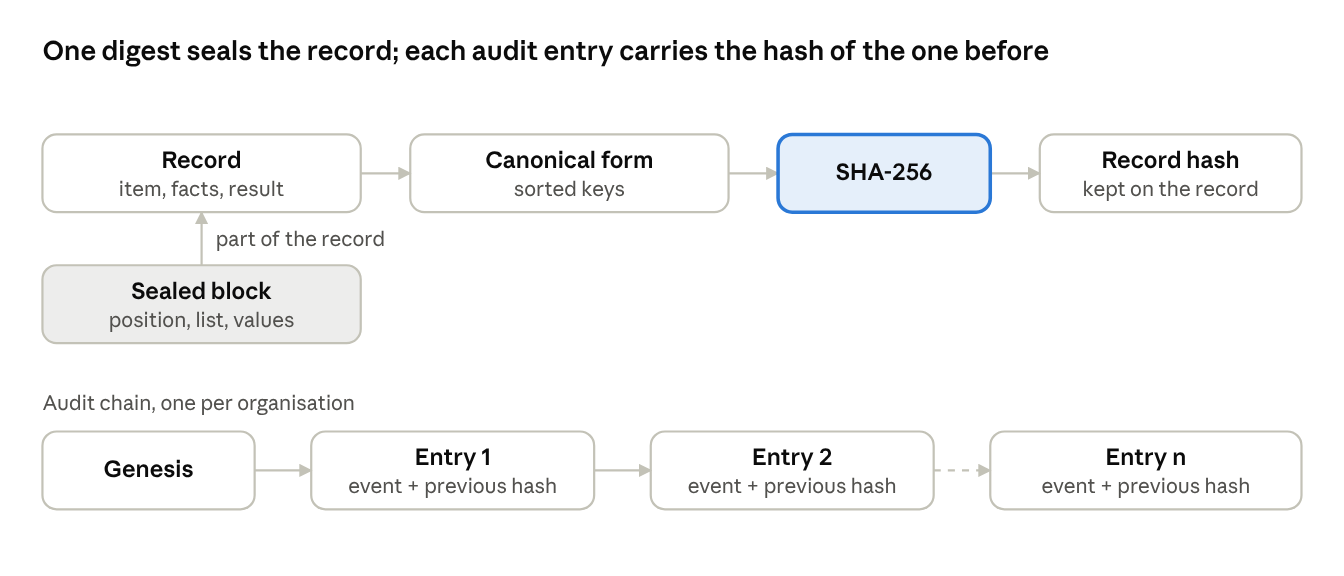
The record holds the item, the list editions, the facts with their sources, the result per list and the decision. The sealed block inside it repeats the position, the list and the values that are also stored as columns beside the record, so that they fall under the same digest. The audit chain is separate: it records events in order, and each entry is bound to its predecessor.
4 Canonical form and seal
4.1 Canonical form
A digest is only reproducible if the bytes it is taken over are. Two JSON documents with the same content can differ in key order and whitespace. We therefore define a canonical form canon(r) of a record r:
the members of every object are ordered by key, at every level of nesting;
a member without a value is left out;
the elements of a list keep their order;
the member that holds the digest itself is left out;
the result is serialised as JSON without insignificant whitespace.
The approach is in the spirit of the JSON Canonicalization Scheme [4]; we do not claim conformance to it. The seal of a record is then
and it is stored on the record. A reader recomputes h(r) from the exported record and compares it with the stored value. Any change to a fact, a source, a result or the decision changes canon(r) and therefore h(r).
4.2 Sealed block
For search and reporting, the confirmed position, its list and the values are also held as columns beside the record. Left alone, such columns could be changed without touching the record (threat T2). Version 2 of the seal closes this by placing a block s inside the record before the digest is taken:
where p is the position, ℓ the list and V the values as they stood when the digest was computed. Verification holds the columns against s:
with starred symbols for the column values read at verification time. The version number is part of the sealed content. A record written before version 2 carries no block, is checked as before, and its digest is never computed anew: recomputing a digest after the fact would defeat its purpose.
5 Chained audit log
The seal protects one record. It does not show whether an event on that record was removed. For this, every organisation has one audit chain. Let be the i-th event: who acted, the action, the object it concerned, the time, the value before and after, and where the request came from. The entry hash is
Each entry stores and . Verification walks the chain in order and checks two conditions per entry:
A changed entry fails the second condition at j. A removed or swapped entry fails the first condition at its successor. The check reports the first position at which the chain breaks, which narrows the time window of a change to the interval between two entries. The construction follows linked time-stamping [2].
6 Security analysis
The guarantees of Sections 4 and 5 reduce to two properties of SHA-256 [1].
Targeted change. To alter a sealed record without detection, an adversary needs a second record with the same digest. For an ideal 256-bit hash each attempt succeeds with probability
Accidental collision. Two different records that happen to share a digest would make one indistinguishable from the other. Among n sealed records the probability of any such pair is bounded by the birthday bound
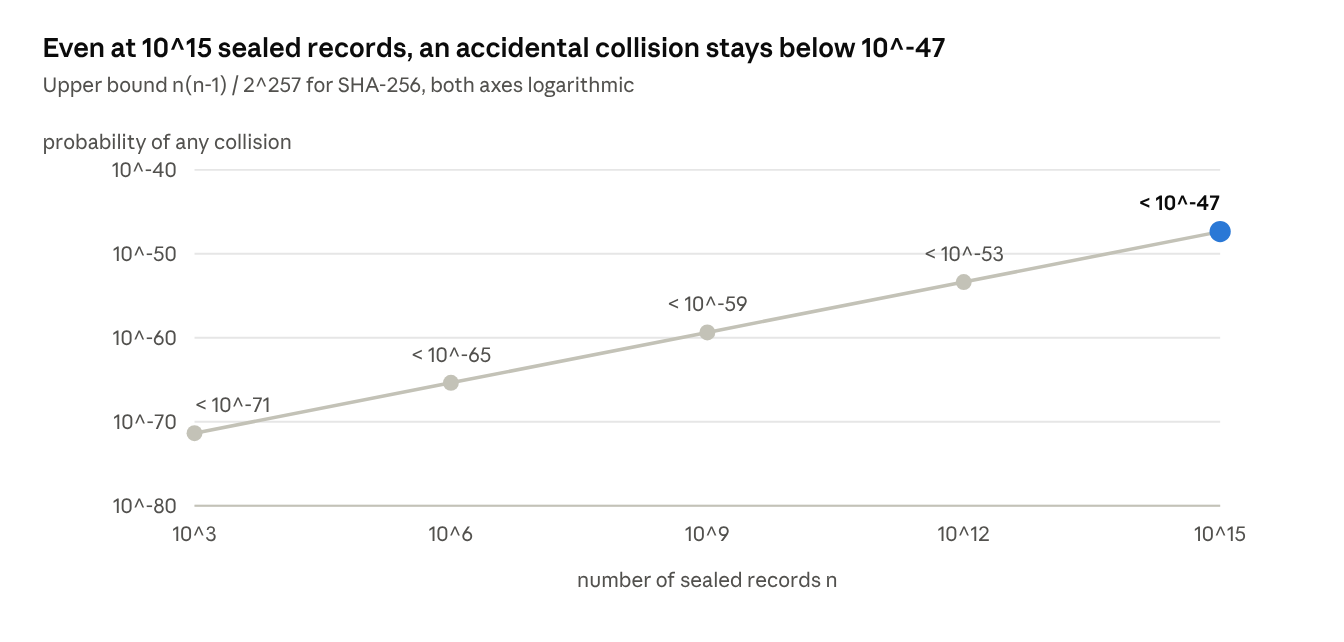
The bound grows with the square of n and still stays far below any rate at which storage hardware itself returns wrong data. The practical risks to the record lie elsewhere: in the facts that go into it and in who controls the head of the chain. Both are treated in Section 9.
7 Verification by a third party
A verifier needs the exported record, the audit entries of the organisation and an implementation of SHA-256. No access to our systems and no secret is required.
Remove the stored digest from the record and build the canonical form (Section 4.1).
Compute SHA-256 over it and compare with the stored digest.
Compare the position, the list and the values shown for the record with its sealed block (Section 4.2).
Walk the audit chain from its genesis value and check both conditions of Section 5 at every entry.
Read the list editions named in the record and, if desired, evaluate the facts against the official text of those editions.
Steps 1 to 4 are mechanical and take milliseconds per record. Step 5 is the substantive review, and the record is built so that it can be done from the record alone: it names every fact with its source and every position that was reached and refuted.
8 Deployment models
The format does not depend on where the software runs. The architecture supports two models:
| Model | Where records and chain are held | Status |
|---|---|---|
| Hosted | In the operator's database in the EU | In operation |
| Customer-operated | On the customer's own infrastructure, with no record leaving its network | By arrangement |
In both models the record, the seal and the chain are defined identically. A record produced in one verifies with the same procedure as a record produced in the other, and an auditor does not need to know which model was used. In the customer-operated model the list editions are delivered as signed packages, so that the edition named in a record can be matched to the package it came from.
9 Limitations and future work
A seal proves integrity, not truth. It shows that a record is unchanged since it was confirmed. It does not show that a fact in it was correct or that the classification was right.
The head of the chain. A party that can rewrite the database can recompute a chain from any entry onwards (threat T5). Detecting this needs a commitment held outside that party's reach. Two options are periodic anchoring of the chain head with an independent time-stamping service, in the manner of [2] and [3], and an append-only store for entries. Both are on our roadmap.
Coverage. The chain covers the events of a classification, and further kinds of event are being added. Records written before version 2 of the seal carry no sealed block and are checked by their digest alone.
Canonical form. Our canonical form is defined in this paper, not by an external standard. A move to the JSON Canonicalization Scheme [4] would let verifiers use existing libraries; it would require a new seal version.
Verifier. A small open verification tool that implements Section 7 is in development, so that the procedure does not depend on our software.
References
National Institute of Standards and Technology, Secure Hash Standard (SHS), FIPS PUB 180-4, 2015.
S. Haber and W. S. Stornetta, “How to time-stamp a digital document”, Journal of Cryptology 3(2), 1991, pp. 99–111.
S. A. Crosby and D. S. Wallach, “Efficient data structures for tamper-evident logging”, Proceedings of the 18th USENIX Security Symposium, 2009.
A. Rundgren, B. Jordan and S. Erdtman, JSON Canonicalization Scheme (JCS), RFC 8785, 2020.
Version history
| Version | Date | Change |
|---|---|---|
| 1.0 | 11 November 2026 | First public version. |
Software is not legal advice. A record documents a classification; it is not an export licence.
Caelex Research, “A Verifiable Evidence Record for Export Control Classification: Canonical Form, Seal and Chained Audit Log”, Methods Paper No. 2, Caelex, Cologne, 11 November 2026. https://www.caelex.eu/research/papers/verifiable-evidence-record
@techreport{caelex2026verifiable,
  title       = {A Verifiable Evidence Record for Export Control Classification: Canonical Form, Seal and Chained Audit Log},
  author      = {{Caelex Research}},
  institution = {Caelex},
  address     = {Cologne, Germany},
  type        = {Methods Paper},
  number      = {2},
  year        = {2026},
  month       = nov,
  url         = {https://www.caelex.eu/research/papers/verifiable-evidence-record}
}