
Research / Papers / Methods Paper No. 3
Data Flow, Trust Boundaries and the Role of Language Models in Export Control Classification
- The classification decision is a function of the list edition and the stated facts only.
- Language models assist behind a gate that withholds protected wording and fails closed.
- Hosted and customer-operated deployments give the same result and the same record.
Abstract
Technical data about controlled goods is itself sensitive, and in some cases its transfer is an export. A system that classifies such goods must therefore be able to say exactly which data goes where. We describe the data flow of the Caelex classification system as a set of data classes, components and permitted flows between them. We state one property formally: the classification decision is a function of the list edition and the stated facts only, and is independent of the output of any language model. Language models appear in assistive functions alone, behind a gate that withholds protected wording and fails closed. We give the processing locations with the evidence we hold for each. Finally we compare two deployment models, hosted and customer-operated, and show that the property holds in both.
Keywords: data flow, trust boundary, non-interference, language models, data residency, export control
1 Introduction
Two questions come up in every conversation with an export control officer before the software itself is discussed. Where does my data go? And is an AI model deciding anything?
Both are reasonable. A datasheet for a controlled component can contain controlled technology. A classification that rests on the output of a statistical model cannot be defended in an audit, because the same input may not give the same output tomorrow.
This paper answers both questions by construction, not by assurance. Section 2 defines the data classes and components. Section 3 draws the trust boundaries and states which class may cross which boundary. Section 4 states formally what a model can and cannot influence. Section 5 lists processing locations. Section 6 treats the customer-operated deployment, in which no customer data crosses the customer's own network boundary.
2 Data classes and components
We distinguish five classes of data.
| Class | Content | Sensitivity |
|---|---|---|
| D1 Item master | Article numbers, descriptions, manufacturer, origin | Commercial |
| D2 Facts | Technical values of an item with their sources | Can describe controlled goods |
| D3 Datasheets | The documents facts are read from | Can contain controlled technology |
| D4 List wording | The official text of list positions | Public; a part is set apart by our safety rules |
| D5 Records | Confirmed classifications with facts, editions and seal | Audit evidence |
The components are: the customer's side (browser, ERP), the rule evaluation, the record store, the assistive functions (locating values in a datasheet, in-product assistance), and an external language model that the assistive functions may call.
3 Trust boundaries and permitted flows
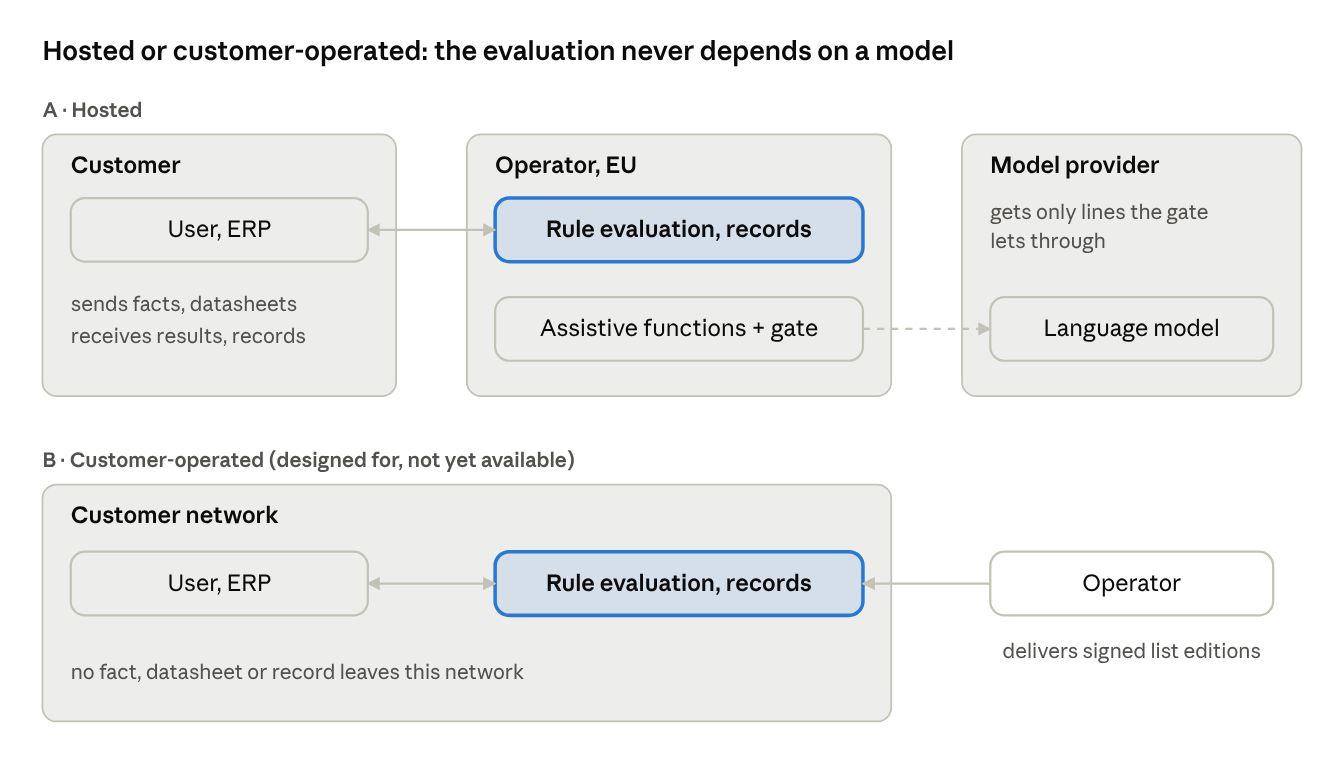
In the hosted model there are two boundaries: between the customer and the operator, and between the operator and a model provider. In the customer-operated model the second boundary does not exist and the first is crossed in one direction only, by list editions coming in.
The permitted flows in the hosted model are:
| Class | Rule evaluation and record store | Language model |
|---|---|---|
| D1 Item master | Yes | Only in an assistive function, through the gate |
| D2 Facts | Yes | Only in an assistive function, through the gate |
| D3 Datasheets | Yes | Single lines, when the organisation has switched on model-assisted reading, through the gate |
| D4 List wording | Yes | Never for wording our safety rules set apart |
| D5 Records | Yes | No |
A flow that is not in this table does not exist in the design. In particular a model's output never enters the rule evaluation directly: a model returns a place in a document or a text for the user, never a list position and never a result. A value read at such a place enters as a proposed fact, marked with its source (Section 4).
4 Formal statement
4.1 The decision is independent of the model
Let E be a list edition, F a set of facts and M a language model. The classification result is computed by a function δ that takes E and F and nothing else (Methods Paper No. 1):
A model appears only in a proposal function π, which maps a datasheet S to proposed facts. The model names a place in S; the value at that place is read by fixed rules ρ:
From this follows the property we rely on. For any two models M₁ and M₂ and any fixed E and F:
In words: replacing, updating or switching off the model cannot change the result for a given set of facts. A model can influence which facts are proposed. It cannot influence how facts are evaluated, and it cannot introduce a value that is not present at a place in the customer's own document. This is a non-interference property in the sense of Goguen and Meseguer [1], with the model as the low-trust input.
4.2 The gate before every model call
Let T be the lines of text a function would send to a model, and held(t) the predicate that a line contains wording our safety rules set apart. The call is made only if no line is held:
The gate is evaluated line by line on the server. If the predicate cannot be evaluated, it counts as held and the model is not called. The gate therefore fails closed: an error leads to no call, not to an unchecked call. An automated test binds every code path that calls a model to this gate.
5 Processing locations
A statement about location is only worth what the evidence behind it is worth. We list each component with the evidence we hold.
| Component | Location | Evidence |
|---|---|---|
| Database (accounts, facts, records) | Frankfurt, Germany | Dated provider exhibit |
| Server functions | Frankfurt region | Deployment configuration |
| Model inference | Data centres in the EU; no storage at the model provider; no training on inputs; a request that cannot be served there is refused | Dated probe of the configuration |
| Uploaded files | Object storage under EU jurisdiction; the EU is documented, a city is not | Dated provider exhibit |
Two qualifications belong to this table. First, the model and cloud providers are companies under United States law. Pinning processing to the EU moves the processing; it does not change the law the provider is subject to. Second, absolute statements such as “data never leaves the EU” are not supported by this table and we do not make them. The current state is published on our data residency page [2].
6 Deployment models
Because the decision function of Section 4.1 needs no model and no external service, the evaluation can run wherever the list edition and the facts are. The architecture supports two deployment models: hosted, and customer-operated for organisations whose technical data may not leave their own network.
| Hosted | Customer-operated | |
|---|---|---|
| Status | In operation | By arrangement |
| Evaluation and record store run | At the operator, in the EU | On the customer's infrastructure |
| Facts, datasheets, records cross the customer's network boundary | Yes, to the operator | No |
| List editions | Compiled and held by the operator | Delivered as signed packages and verified on arrival |
| Assistive model functions | Per organisation, through the gate | Off, unless the customer connects a model it operates itself |
| Record format and seal | As in Methods Paper No. 2 | Identical |
| Result for the same edition and facts | δ(E, F) | δ(E, F), identical |
The last two rows are the point. A classification made in one model can be verified and re-evaluated in the other, because neither the result nor the record depends on where it was computed. The customer-operated model exists for goods whose technical data may not be handed to any third party, such as items of Annex IV or military goods.
7 Limitations
The property of Section 4.1 is about evaluation, not about facts. A model that points to the wrong place can lead to a wrong proposed fact. The source on every fact and the confirmation by a person are the controls for this, and they depend on the person looking.
The gate is conservative. It withholds a line when in doubt. Some harmless lines are therefore not sent, and the assistive function does less than it could.
Evidence is dated. A location documented on one day can change with a provider's configuration. The table in Section 5 states what we could show on the dates of the exhibits, not a permanent fact.
Customer-operated deployments are scoped individually. Packaging, updates and support for such a deployment are agreed with the customer and are not part of this paper.
Not legal advice. Whether a given data transfer is itself an export under the law that applies to a customer is a legal question this paper does not answer.
References
J. A. Goguen and J. Meseguer, “Security policies and security models”, Proceedings of the IEEE Symposium on Security and Privacy, 1982, pp. 11–20.
Caelex, Data residency. caelex.eu/legal/data-residency
Caelex Research, Deterministic Classification of Goods against Export Control Lists: Method and Guarantees, Methods Paper No. 1, 2026. caelex.eu/research/papers/deterministic-classification
Caelex Research, A Verifiable Evidence Record for Export Control Classification, Methods Paper No. 2, 2026. caelex.eu/research/papers/verifiable-evidence-record
Version history
| Version | Date | Change |
|---|---|---|
| 1.0 | 11 November 2026 | First public version. |
Software is not legal advice.
Caelex Research, “Data Flow, Trust Boundaries and the Role of Language Models in Export Control Classification”, Methods Paper No. 3, Caelex, Cologne, 11 November 2026. https://www.caelex.eu/research/papers/data-flow-and-language-models
@techreport{caelex2026data,
  title       = {Data Flow, Trust Boundaries and the Role of Language Models in Export Control Classification},
  author      = {{Caelex Research}},
  institution = {Caelex},
  address     = {Cologne, Germany},
  type        = {Methods Paper},
  number      = {3},
  year        = {2026},
  month       = nov,
  url         = {https://www.caelex.eu/research/papers/data-flow-and-language-models}
}