
Research / Papers / Position Paper No. 4
Law, Computed: A Research Programme for the Deterministic and Verifiable Application of Regulatory Norms
- Threshold law, written as measurable conditions and fixed thresholds, can be applied by computation without giving up fidelity to the enacted wording.
- Stability theorem: a decision, once reached, is not overturned by learning more facts.
- First measurement: 38 % of the leaf positions of Annex I to Regulation (EU) 2021/821 carry at least one numeric threshold.
Abstract
A growing share of regulatory law is written like a specification: a kind of object, a measurable quantity, a threshold, a consequence. Such law is still applied by people reading text against documents, one case at a time. We argue that this class of law, which we call threshold law, can be applied by computation without giving up what makes law law: fidelity to the enacted wording, room for judgement where the wording asks for it, and a record that others can check. We give a formal model in which a norm is a formula over stated facts, evaluated in three-valued logic, and prove the one property a legal application must have: a missing fact can never produce a permission. We report a first measurement on a real instrument, Annex I of the EU dual-use regulation, in which 38 % of the leaf positions carry at least one numeric threshold. We then state five open research problems and the domains beyond export control in which we expect the model to hold. The paper sets out a research programme: what the model establishes, and what remains open.
Keywords: computational law, rules as code, three-valued logic, open texture, regulatory compliance, verifiable decisions
1 Introduction
Consider two sentences of law. The first says that a contract must be performed in good faith. The second says that an analogue-to-digital converter is controlled if its resolution is 14 bit or more and its output rate exceeds a stated number of samples per second. Both are binding. They are different kinds of text.
The first is an instruction to a judge. Its meaning is settled case by case, and no amount of data about the contract decides it. The second is a predicate. Given two numbers from a datasheet it is true or false, and it would be true or false in the same way for anyone who evaluated it.
Law of the second kind has grown quickly. Export control lists, chemical and product regulation, emission limits, capital requirements, cybersecurity obligations with fixed reporting periods: all name measurable quantities and fixed thresholds, because they regulate technology and technology is described in numbers. Yet the way such law is applied has not changed. A person reads the text, reads the documents, compares, and writes down a conclusion. The conclusion is rarely reproducible and almost never verifiable by a third party.
Our thesis is that this is a historical accident and not a necessity:
Where the enacted wording is a predicate over measurable facts, its application can be computed, and where it is not, the computation can say so precisely and ask a person.
The second half matters as much as the first. A system that only computes the easy part and guesses the rest is worse than no system. The contribution of this programme is the boundary: a model in which the computable part and the part reserved for judgement are separated exactly, with a guarantee about what happens at the line between them.
2 Related work
The idea that statutes can be executed is forty years old. Sergot and colleagues encoded the British Nationality Act as a logic program [1] and showed both that it could be done and where it strained: negation, exceptions, and terms the Act leaves undefined. McCarty's TAXMAN [2] had earlier modelled corporate tax concepts and met the same wall, which Hart had named decades before as the open texture of legal language [3]: general terms have a core of settled meaning and a penumbra where they do not decide.
Two lessons from that literature shape our approach. Bench-Capon and Coenen [4] argued for isomorphism: a formal representation should correspond unit by unit to the source text, so that it can be checked and maintained when the text changes. And work on defeasible reasoning showed that exceptions are not an annoyance but the normal structure of law.
More recently, Catala [5] has given a programming language designed around the default-and-exception structure of statutes, used for tax and benefit law. Surden [6] and Genesereth [7] have argued for computable contracts and computational law more broadly. In parallel, large language models are now applied to legal text. They read fluently and answer plausibly, and they offer neither reproducibility nor a guarantee about what they do when a fact is missing.
Our programme differs from the first line in its target and from the last in its method. We do not attempt to formalise law in general. We restrict ourselves to threshold law, where formalisation is faithful, and we treat the residue of open-textured terms not as a failure of the encoding but as typed questions to a person. And we do not use a statistical model to decide anything.
3 A model of threshold law
3.1 Atoms, facts and norms
We distinguish two kinds of atomic condition.
A measurable atom compares an attribute of the regulated object with a threshold fixed in the text: resolution ≥ 14 bit, mass > 500 kg, period ≤ 72 hours.
A judgement atom is a clause of the text that no measurement decides: “specially designed for”, “capable of”, “primarily intended”. It is answered by a person with yes or no.
A set of facts F is a partial assignment: it gives values to some attributes and answers to some judgement atoms, and is silent on the rest. We write F ⊑ when agrees with F wherever F is defined and may be defined on more.
A norm n consists of a condition φ, a set of exceptions X and a consequence c. It applies when its condition holds and none of its exceptions does:
Conditions and exceptions are built from atoms with conjunction and disjunction, following the “all of the following” and “any of the following” of the text. A legal instrument in a given edition is a finite set of such norms, arranged in the tree of its headings.
3.2 Evaluation
Under a partial F, an atom is met (1), refuted (0) or undetermined (⊥), and formulas are evaluated with Kleene's strong connectives [8]:
3.3 Three properties
Theorem 1 (stability). If F ⊑ and v(φ, F) is 0 or 1, then v(φ, ) = v(φ, F).
Proof sketch. Order the truth values by information, with ⊥ below both 0 and 1. An atom is monotone in this order, because extending F never changes a value F already gives. Kleene's strong connectives are monotone in each argument. By induction on the structure of φ, v(φ, ·) is monotone, and a value that is already 0 or 1 has nothing above it but itself. ∎
The theorem says that a decision, once reached, is not overturned by learning more. Only an open result can still move. For law this is the property that makes it safe to stop asking.
Corollary (fail-safe). A norm is never found inapplicable because a fact is missing. If v(applies(n), F) = 0, then F contains stated facts that refute it.
Proposition 2 (witness). If v(φ, F) is 0 or 1, there is a subset W of F, containing only atoms that occur in φ, with v(φ, W) = v(φ, F).
W is the justification. It is what a record prints as the reason for a result: these values met these conditions, or this value refuted that one. A decision without a witness cannot occur in the model.
Proposition 3 (questions). If v(φ, F) = ⊥, the set of atoms of φ on which F is silent is finite and non-empty, and any that extends F to all of them decides φ.
An open result therefore always comes with a finite list of what to ask, and the list is a consequence of the text and the facts, not a product of a dialogue system.
3.4 Open texture as a typed residue
In this model the open texture of law does not disappear. It is confined to judgement atoms, each tied to the exact words of the text it stands for, each answered by a named person, and each recorded with the answer. The boundary between what was computed and what was judged is part of every result.
4 How much of a law is computable?
The model is only useful if real instruments consist largely of measurable atoms. This is an empirical question, and it can be measured.
We took one instrument, Annex I to Regulation (EU) 2021/821 [9], in the form in which our compiler represents it, and counted for every leaf position whether its condition contains at least one numeric comparison. A leaf position is a lowest-level item of the list, the level at which a good is finally classified.
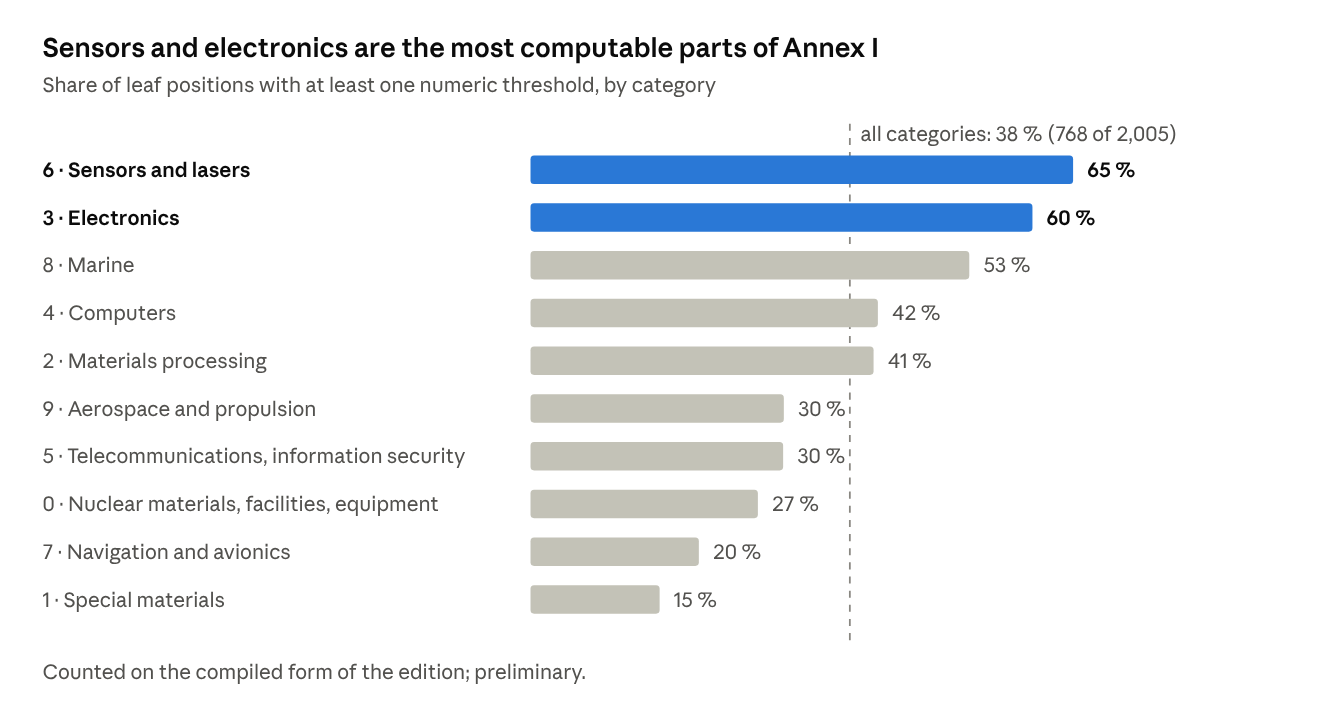
The share differs by a factor of four between categories. Where the list regulates devices with data sheets, most positions carry a number. Where it regulates materials and substances, positions name the thing itself and a number is rare. Two cautions apply. A position without a number is not thereby a matter of judgement: many name a kind of item that is identified, not measured. And the count is taken on our compiled form of the list; it is a first measurement. The full measurement classifies every atom as measurable, identifying or judgement, on the official text, with a second annotator. That is research problem P1 below.
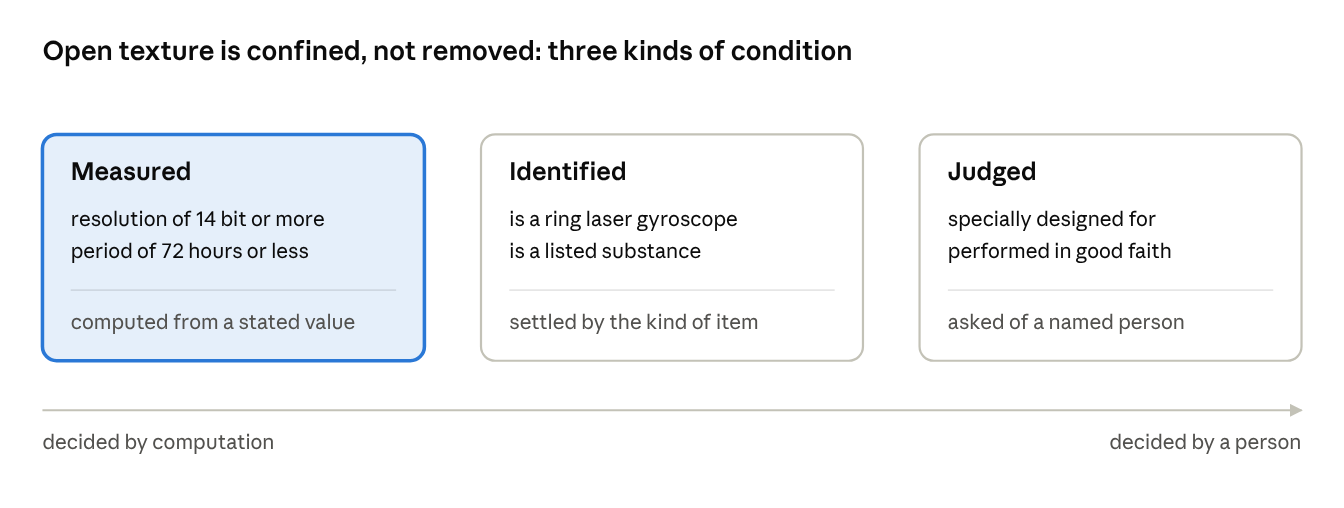
The figure states the classification we propose for that measurement. Threshold law is law in which the first two kinds dominate and the third is rare enough to be asked one question at a time.
5 Five research problems
The model of Section 3 is simple. What is hard lies around it. We state five problems on which the programme stands or falls, each with what would count as progress.
P1 · Faithful compilation. Turning enacted text into the formulas of Section 3 is itself an act of reading, and it can be wrong. A threshold read as an equality, a band read too narrowly or an exception attached one level too high changes results silently. The problem is to measure and bound this error: an annotated reference for one instrument, a deviation rate per kind of construct, and checks that fail when the compiled form and the text part ways. Sampling against the official text finds such deviations, which is why we name this problem first.
P2 · Law as a versioned object. Instruments change. If a decision is a function of an edition and facts, a new edition defines exactly which past decisions can differ: those whose witness (Proposition 2) touches a changed norm. The problem is incremental re-evaluation with a guarantee that nothing outside that set needs to be looked at, and a readable account of what a change in the law did to a given portfolio.
P3 · Evidence. A computed application of law is only worth something if a third party can check it without trusting the system that produced it. Methods Paper No. 2 specifies a record format with a seal and a chained log. Open is the question of commitments held outside the operator's reach.
P4 · Composition across instruments. The same object is usually subject to several instruments at once, from different legislators, with overlapping and sometimes diverging terms. The problem is to evaluate one set of facts against many instruments, to detect where two instruments use the same word for different thresholds, and to state the combined result without inventing a hierarchy the law does not contain.
P5 · The place of learning systems. Language models are good at the step this model leaves open: finding in a 40-page document the place where a value is stated. They are unsuited to the step the model closes. The problem is an interface under which a model can propose where to look and nothing more, with the non-interference property of Methods Paper No. 3 preserved. A related question is whether a model can assist compilation (P1) under the same discipline: propose a reading, never fix one.
6 Beyond export control
We developed the model on export control lists because they are the purest threshold law we know: long, technical, numeric, and amended every year. Nothing in Section 3 is specific to them. A domain is a candidate when three conditions hold:
| Condition | Question to ask of the instrument |
|---|---|
| Measurable atoms dominate | Can most conditions be answered from a technical document? |
| The wording is fixed and published | Is there an official text in editions, and is each condition traceable to it? |
| The costly error is asymmetric | Is wrongly concluding “does not apply” much worse than asking one question too many? |
By these conditions we see four families of candidates: lists of controlled or restricted goods and substances; product rules with numeric limits; obligations triggered by size or activity thresholds, such as those that decide whether an entity falls under a cybersecurity regime; and authorisation regimes for technical systems. In space regulation the last family is taking shape now: the proposed EU Space Act, COM(2025) 335, is a proposal and not in force.
We make no claim about these domains beyond the conditions above. Whether the measurement of Section 4 looks similar for another instrument is exactly the kind of result this programme should produce next.
7 What this is not
Not a theory of law. Most law is not threshold law. Contract, liability, constitutional and criminal law turn on judgement, and nothing here applies to them.
Not automation of decisions. In the model a person answers every judgement atom and confirms every result. The computation removes the reading and comparing, not the responsibility.
Not legal advice. A computed result is an application of stated facts to a stated text. Whether the facts are right, whether the text is the applicable one and what follows from the result are questions for the person responsible.
Not finished. The model runs on the dual-use lists of three jurisdictions. The five problems above are open, and they are the work.
References
M. J. Sergot, F. Sadri, R. A. Kowalski, F. Kriwaczek, P. Hammond and H. T. Cory, “The British Nationality Act as a logic program”, Communications of the ACM 29(5), 1986, pp. 370–386.
L. T. McCarty, “Reflections on TAXMAN: an experiment in artificial intelligence and legal reasoning”, Harvard Law Review 90(5), 1977, pp. 837–893.
H. L. A. Hart, The Concept of Law, Oxford University Press, 1961, ch. VII.
T. J. M. Bench-Capon and F. P. Coenen, “Isomorphism and legal knowledge based systems”, Artificial Intelligence and Law 1(1), 1992, pp. 65–86.
D. Merigoux, N. Chataing and J. Protzenko, “Catala: a programming language for the law”, Proceedings of the ACM on Programming Languages 5(ICFP), 2021.
H. Surden, “Computable contracts”, UC Davis Law Review 46, 2012, pp. 629–700.
M. Genesereth, “Computational law: the cop in the backseat”, CodeX, Stanford Center for Legal Informatics, 2015.
S. C. Kleene, Introduction to Metamathematics, North-Holland, 1952, § 64.
Regulation (EU) 2021/821 of the European Parliament and of the Council of 20 May 2021 (recast), Annex I, as amended.
Version history
| Version | Date | Change |
|---|---|---|
| 1.0 | 11 November 2026 | First public version. |
Software is not legal advice.
Caelex Research, “Law, Computed: A Research Programme for the Deterministic and Verifiable Application of Regulatory Norms”, Position Paper No. 4, Caelex, Cologne, 11 November 2026. https://www.caelex.eu/research/papers/law-computed
@techreport{caelex2026law,
  title       = {Law, Computed: A Research Programme for the Deterministic and Verifiable Application of Regulatory Norms},
  author      = {{Caelex Research}},
  institution = {Caelex},
  address     = {Cologne, Germany},
  type        = {Position Paper},
  number      = {4},
  year        = {2026},
  month       = nov,
  url         = {https://www.caelex.eu/research/papers/law-computed}
}