
Research / Papers / Research Paper No. 5
One Regime, Three Texts: Measuring the Divergence of Allied Dual-Use Control Lists
- The UK list is word-for-word identical to the EU list at 78 % of the positions compared.
- The US list is identical to the EU list at 10 %; a further 42 % differ only in typography and 44 % differ in words.
- Equivalence across lists has to be established position by position, not assumed from the number.
Abstract
The dual-use control lists of the European Union, the United Kingdom and the United States implement the same multilateral export control regimes and share a numbering scheme. In practice this leads to a working assumption: a position with the same number says the same thing in each jurisdiction, so an item classified once is classified everywhere. We test this assumption at the level of wording. We align the three lists position by position and compare, for each aligned position, its own text, the headings it inherits, its sub-items, its references and its Notes. Of the positions compared, the UK list is word-for-word identical to the EU list at 78 %. The US list is identical to the EU list at 10 %; a further 42 % differ only in typography, and 44 % differ in words. A difference in words is not yet a difference in scope, and we do not claim one. But the result shows that equivalence across these lists is a property to be established position by position, not one to be assumed from the number. We state what remains open, in particular which of the differences change what is controlled.
Keywords: export control, dual-use, Wassenaar Arrangement, regulatory divergence, text comparison, defence and space supply chains
1 Introduction
A reaction wheel built in Germany with a sensor from the United Kingdom and an integrated circuit of US origin is subject to three export control regimes at once. The engineer who classifies it will typically do so once, against the list she knows, and carry the result over: the EU position 3A001 and the US ECCN 3A001 have the same number, after all.
The assumption is reasonable. All three lists transpose the control lists agreed in the multilateral regimes, above all the Wassenaar Arrangement [1], and the numbering was designed to line up. The assumption is also untested in the open literature, as far as we know, at the level where it matters: the exact words of each position. Thresholds are in the words. So are the qualifiers that decide whether a threshold applies.
For defence and space supply chains the question is not academic. Components cross these three jurisdictions routinely, re-export rules make the US list relevant to goods that never touch US soil, and a classification carried over on the strength of a number is a classification nobody actually made.
This paper asks one question and answers it with a measurement:
For positions that exist under the same identifier in two lists, how often is the wording the same?
2 Background
The lists compared are Annex I to Regulation (EU) 2021/821 [2], the UK consolidated list of dual-use items [3] and the Commerce Control List of the US Export Administration Regulations [4]. Each is amended roughly once a year after the regime plenaries.
The three share an architecture. An identifier names a category (0 to 9), a product group (A to E) and a number whose first digit points to the regime of origin. Below the entry, sub-items are lettered and numbered in a tree. The UK list descends directly from the EU list: until the end of 2020 the EU regulation applied in the UK, and the UK has maintained its own text since. The US list is drafted independently by the Bureau of Industry and Security and carries additional US-only entries, which have no counterpart and are outside this comparison.
3 Method
Alignment. Two positions are aligned when they carry the same identifier down to the last level of sub-item. Positions that exist in only one list are not part of the comparison.
What is compared. For each aligned position we compare five things: its own wording; the wording of each heading above it, since a sub-item applies only within its headings; the wording of the items below it; the entries it refers to; and its Notes. Texts are normalised for whitespace before comparison.
Classes of result. Each aligned position falls into exactly one class:
| Class | Meaning |
|---|---|
| Identical | All five agree character for character after normalisation |
| Typography only | The only differences are letter case, punctuation or quotation marks |
| Wording differs | At least one word differs in the position, a heading above it, an item below it or a reference; or the structure below it differs |
| Notes differ | The texts agree; the Notes attached do not |
Editions. EU: Annex I as amended by Delegated Regulation (EU) 2025/2003. UK: the list as amended in 2025. US: the Commerce Control List in force at the start of 2026. The comparison was run in November 2026.
Exclusions. Positions in categories we handle as sensitive (nuclear, chemical, biological and energetic materials, missile-related and military entries), together with two further groups of entries set apart by our handling rules, are excluded from wording-level analysis. They are counted, not compared. This is a substantial part of the lists: 57 % of aligned positions for EU and UK, 48 % for EU and US. The results below describe the remainder.
4 Results
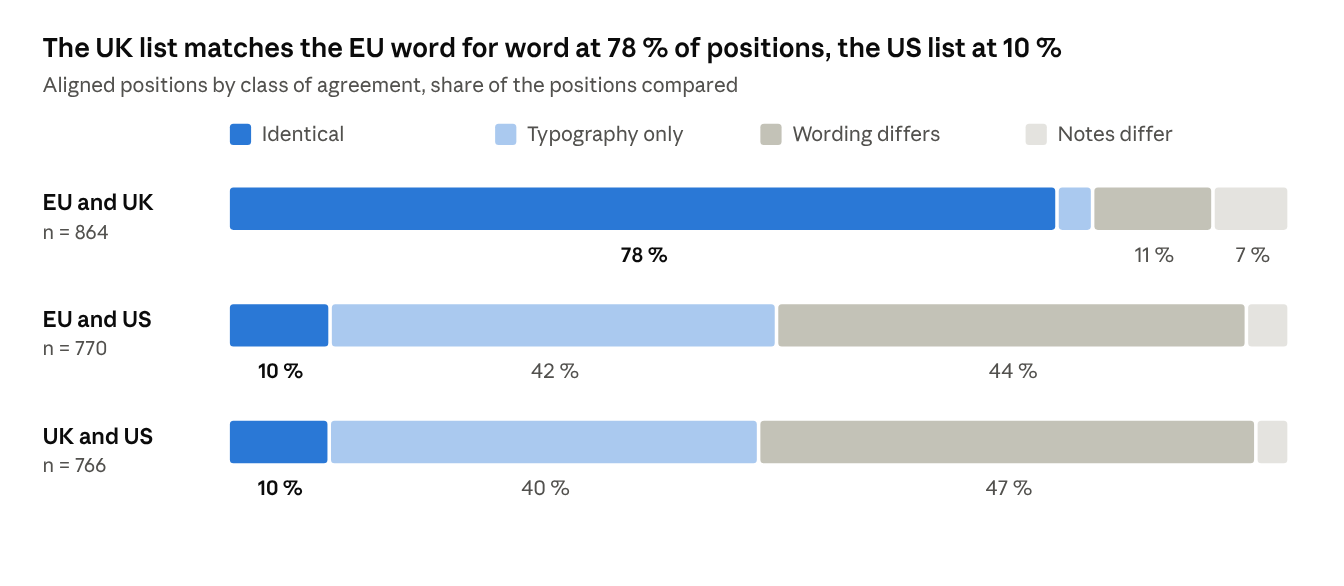
Three observations follow from the figure.
The UK and EU lists are close but no longer the same. Six years after the texts separated, about one compared position in five differs: 98 in wording, 62 in the Notes attached to an otherwise identical text, 29 in typography alone.
The EU and US lists are rarely identical and often merely typeset differently. Only one position in ten matches character for character. Four in ten differ solely in letter case, punctuation or the use of quotation marks. If typography is set aside, 52 % of positions agree in their words.
The remaining difference is real text. For EU and US, 341 of 770 compared positions differ in at least one word. In 130 of them the differing words sit in a heading that the position inherits, in 206 in the position's own text. A single divergent heading therefore accounts for several positions below it, and the number of distinct textual differences is smaller than the number of positions affected. We have not yet counted distinct differences.
The UK and US comparison mirrors the EU and US one almost exactly, as expected from the closeness of the UK and EU texts.
5 Discussion
What the measurement shows. Identity of identifier does not imply identity of text. For the EU and US lists it implies it in one case out of ten. A classification carried from one list to the other on the strength of the number alone therefore rests, in most cases, on a text nobody compared.
What it does not show. A difference in wording is not a difference in what is controlled. Two drafters can describe the same threshold in different sentences, and a Note in one list can restate what the other puts in the position itself. Our measurement cannot tell these cases from a real difference in scope, and we make no claim about how many of the 341 differing positions control something different.
A consequence for computation. In a system that evaluates facts against the wording of a list (Methods Paper No. 1), an answer given for a clause in one list may be reused for another list only where the two clauses are the same text. The classes of this paper give that rule a precise form: reuse is sound for identical positions, defensible for typography-only positions after normalisation, and unsound without a person's review for the rest. This is the practical reason we built the comparison.
A note on typography. That 42 % of EU and US positions differ only in case, punctuation and quotation marks is not trivial. Quotation marks mark defined terms in these lists, and whether a term is used in its defined sense can change the reach of a position. We have not yet separated differences in the quotation character from differences in which terms are marked. We have classified both as typography because that is what they are on the page; some of them may prove to be more.
6 Open questions
Which differences change scope? This is the question that matters and the one we cannot answer by counting. It needs annotation by export control experts: for a sample of differing positions, does a real item exist that one text controls and the other does not? We propose a sample stratified by category and by class of difference, judged independently by two experts.
Do the lists converge or drift? Each regime plenary produces changes that all three jurisdictions then transpose, at different speeds. Comparing successive editions would show whether the distance measured here shrinks after each round or accumulates.
How many distinct differences are there? A divergent heading is counted once per position below it. Counting distinct textual differences, and weighting them by the positions they affect, would give a fairer picture of drafting effort than of exposure.
The excluded half. The categories excluded here are among the most sensitive. A comparison of those entries has to be done by people authorised to handle them, and it may look different.
Beyond three lists. Further jurisdictions that publish lists on the same architecture can be added to the comparison with the same method, as can the military lists.
7 Threats to validity
Coverage. The results describe 43 % of aligned EU and UK positions and 52 % of aligned EU and US positions (Section 3, Exclusions). They are not a statement about the lists as a whole.
Alignment by identifier. Where one list splits an item that another keeps whole, or renumbers a sub-item, positions are not aligned and fall out of the comparison. This understates divergence.
Inheritance. Heading differences propagate to every position below. This overstates the number of independent differences (Section 6, question 3).
Our own representation. The comparison runs on position trees that we extract from the official texts. Extraction errors would appear as differences or hide them. We publish the method so that the comparison can be replicated independently.
Editions. The three editions compared were not in force on exactly the same day. Part of the measured distance is a difference in transposition speed, not in drafting.
Not legal advice. Nothing here says how an item is to be classified under any of the three lists.
References
Wassenaar Arrangement on Export Controls for Conventional Arms and Dual-Use Goods and Technologies, List of Dual-Use Goods and Technologies and Munitions List, as amended.
Regulation (EU) 2021/821 of the European Parliament and of the Council of 20 May 2021 (recast), Annex I, as amended by Commission Delegated Regulation (EU) 2025/2003.
United Kingdom, Department for Business and Trade, UK Strategic Export Control Lists (consolidated list of strategic military and dual-use items that require export authorisation).
United States, Export Administration Regulations, 15 CFR Part 774, Supplement No. 1 (Commerce Control List).
Caelex Research, Deterministic Classification of Goods against Export Control Lists: Method and Guarantees, Methods Paper No. 1, 2026. caelex.eu/research/papers/deterministic-classification
Version history
| Version | Date | Change |
|---|---|---|
| 1.0 | 11 November 2026 | First public version. |
Software is not legal advice.
Caelex Research, “One Regime, Three Texts: Measuring the Divergence of Allied Dual-Use Control Lists”, Research Paper No. 5, Caelex, Cologne, 11 November 2026. https://www.caelex.eu/research/papers/one-regime-three-texts
@techreport{caelex2026one,
  title       = {One Regime, Three Texts: Measuring the Divergence of Allied Dual-Use Control Lists},
  author      = {{Caelex Research}},
  institution = {Caelex},
  address     = {Cologne, Germany},
  type        = {Research Paper},
  number      = {5},
  year        = {2026},
  month       = nov,
  url         = {https://www.caelex.eu/research/papers/one-regime-three-texts}
}